
Urban Fishing in Chicago

Updated: Mar 24

Fishing in Chicago, on foot, is like navigating an obstacle course of concrete, steel, and invisible boundaries—both physical and social. Briny liquids burp out from pipes. Pigeons flap overhead. Sunken Divvy bikes lay hidden below, ready to snag your line. You wait for a gap between boats and kayaks. But just before you cast, a tourist steps up to record a video of you and where you’re fishing at.
The traffic, the chatter, the constant interruptions—it’s enough to make most people quit, or never even consider fishing here in the first place. But then there are the others. The anglers who ignore the noise, look past the sewer overflows, and fish anyway. With a fishing rod, and enough perseverance, they encounter what’s swimming below.
Atop the walls of the Riverwalk, I met two such anglers, Jordan Gils and Jeff Williams, as they were casting out bait for common carp and jigging worms for bluegill. Jordan and Jeff are diehards who are intimately familiar with all of the Chicago River’s challenges and opportunities. Once, they (willingly) bivied in sleeping bags along the river for an entire week—just so they could stay on the water and continue decoding the behaviors of the fish. And they would’ve stayed longer if not for a cranky passerby who called the authorities. It might be strange to have that level of commitment (or addiction) for fishing but spend time with anglers like Jordan and Jeff and you’ll find that it’s part of a deeper connection to local waters—something that can’t easily be shaken off, no matter how much they are paved over with streets, parking lots, and sidewalks.
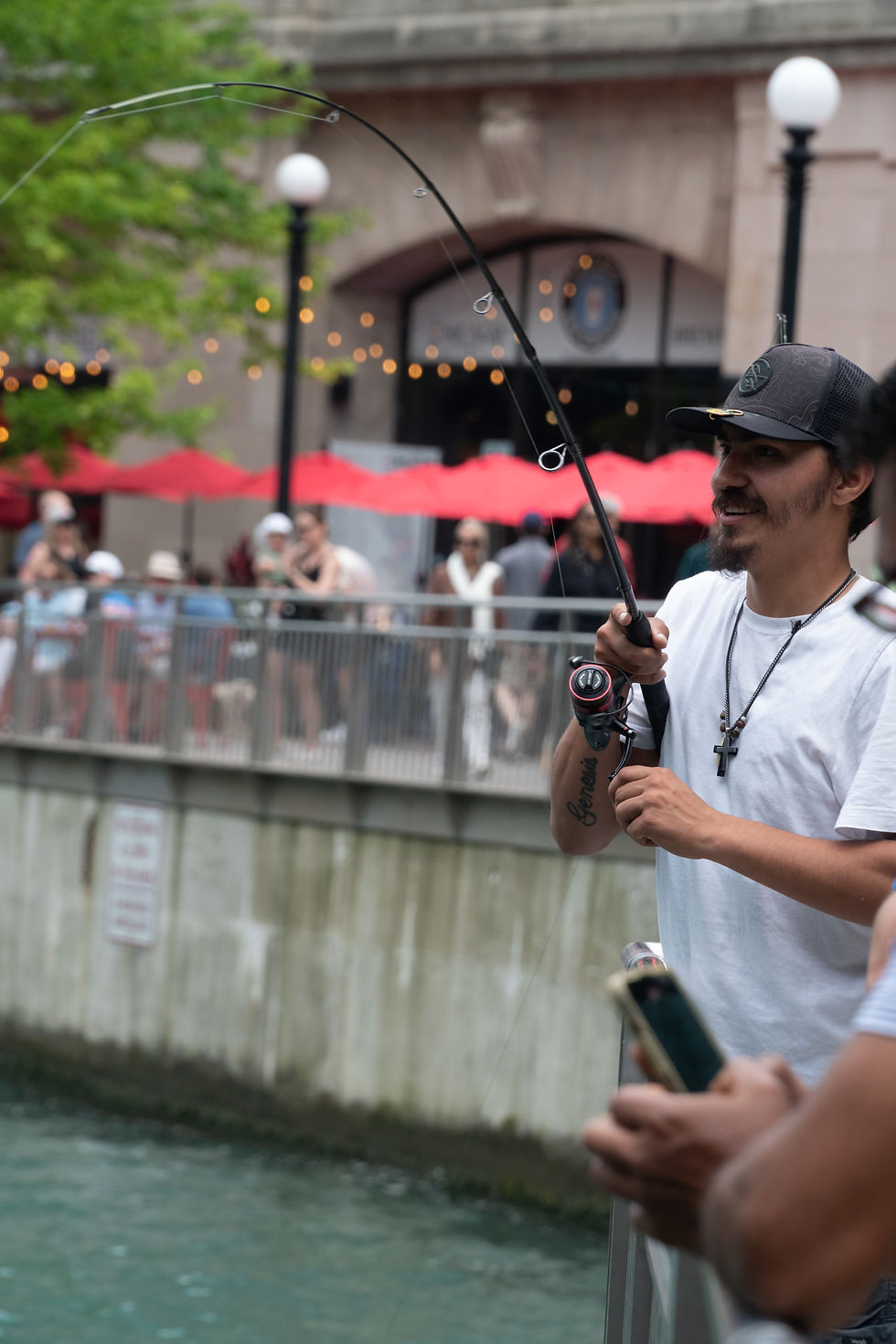
Jordan (host of the YouTube channel Let's Get 'em Fishing) has been fishing the Riverwalk for over thirteen years, and along the way he’s modified his fishing techniques and crafted pack baits to catch hefty carp, including a fifty-pounder. Among other ingredients, his bait recipe is a finely tuned concoction of cherry flavored Jell-O, old fashioned oats, Panko breadcrumbs, corn, and (sometimes) liquor. It’s a mix of salty, savory, sweet, and spicy that draws in even the most stubborn carp.
During one of his epics with a large carp, the fish made a dashing run out to the middle of the river towards the traffic of boats. A veteran captain saw Jordan’s fishing line racing out in front of his vessel, and he quickly reversed thrust to prevent cutting the line. Over the radio, the captain told nearby boats to hold back and maintain distance as Jordan reeled the fish in. When the carp finally slid into the net the entire river erupted in applause.
As exciting as these fishing experiences are, Jordan and Jeff don’t take it for granted. Their right to fish along the Chicago Riverwalk has been challenged by authorities, security guards, and opinionated onlookers. Jordan and Jeff have to educate themselves on the complex legality of fishing regulations, water access rights, angler harassment laws, and municipal codes. Jeff takes it even further, writing and calling city officials reminding them of the public’s desire to access and fish these waters. Like many other impassioned local anglers, this is their home water, and whether they’re calling out someone for tossing trash into the river, answering questions about what species they are catching, or teaching kids how to use a reel, they serve as ambassadors, revealing an entire urban ecosystem to those unfamiliar with it—or those who’ve never thought to appreciate it.
At one point, much earlier in Jordan’s life, fishing and being on the water took on a whole other meaning. After his parents had tossed him out onto the streets, the river was there to take him in. Under the bridges, it was no longer just fishing for the sport of it.
“Do you still eat fish out of the river?” I ask him.
“No. Even though they cleaned up some of the water for the tourists, and it’s no longer brown, it’s still too polluted.”
“So, what is that keeps you coming back to the river?”
Jordan leans against the metal railing and looks into the water, “Once the rod is in your hand and the line hits the water everything zones out. It’s zen.”
Cody, a friend of theirs, nods his head in agreement, “The water calms my brain.”
As we continue talking, Jordan also describes the joy of teaching other anglers how to use certain fishing techniques. He even shares his bait with newcomers who show a respect for the river. For him, while catching a record fish and gaining recognition are important, bringing the local fishing community together is vital.
“And who wouldn’t want to fish in front of the best city in the world?” Jordan says motioning his arm out towards the canyon of towers, glass, concrete, and steel.
Then, the tip of his rod taps. Jordan’s arm jolts up, the light rod bends over, and he steers a bluegill away from the zebra mussel-covered wall.

Fishing in Chicago is also like engaging with a living classroom. The doorway into that classroom is a fishing rod through which you have a chance to take part in and learn from the aquatic world—a world we may assume there isn’t much too as we drive by. But it’s complex and ready to be seen and felt as something very much alive. It’s exciting discovery and street-level ecology.

On the South Side of Chicago, I catch up with four fishing instructors from the Illinois Urban and Community Fishing Program who are shuffling around making final checks on their classroom. A row of evenly spaced fishing rods leans against a long span of metal railing. The instructors move from rod to rod piercing wiggling worms onto the hooks. Several feet below the metal railing, the translucent waters of Lake Michigan lap against the concrete wall.
One of the purposes of the Urban and Community Fishing Program is to introduce inner-city kids to fishing, right in their own neighborhoods. Vince Ramirez, a math teacher and veteran angler with decades of experience, sees local waters as blue spaces where kids can engage with dynamic ecosystems. Through the program, it’s one small way for him to give back and bring out the same curiosity for the watery world that was brought out of him early in life.

Soon enough, across the park a gaggle of kids are heard before seen. Guided by a handful of young summer camp counselors, the group makes their way closer to the metal railing and heads begin to bounce up and down when they see the row of fishing rods. After Vince gives a quick introduction, the kids are directed to their stations.
Rakeem Brown, a special education teacher with a degree in urban studies and masters in education, and Michael Kamp, who’s worked in conservation jobs and has a degree in biology and masters in environmental conservation, help the kids cast their lines out into the water. Both Rakeem and Michael grew up fishing and are passionate not only about introducing kids to accessible fishing opportunities but using it as a bridge into other potential interests, like biology, urban studies, or local conservation.

A squeal goes up in the air, down the railing a fishing rod is bent over and twitching: the first fish is on the line. Then another squeal, and another rod twitches. At just a couple inches long, goby fish don’t put up a ferocious fight, but the excitement from the kids would tell you otherwise. Round goby are not historically native to Lake Michigan, they were introduced in 1990 through ship ballast water discharge and have since spread tremendously across the Great Lakes.
Vince walks over and starts unhooking the gobies and holds them out for the kids to touch. Some are bit more curious and cradle the fish in their hands, but all the kids show fascination and ask insightful questions: What do they eat? What’s invasive? Where did they come from? Does it feel pain?
After each catch, the kids shuttle their gobies over to a small bucket where the fish swim around for just a little longer. Nearby, seagulls impatiently pace back and forth.
Fifteen minutes into the fishing session, one of the kids drops her fishing rod to the ground and folds her hands over her eyes. She has yet to catch anything and her friends on either side of her have each reeled in multiple fish. The young girl leaves the water and is walked over to a park bench where she sits in the shade while her friends continue to catch more fish.
Kristin Ramirez, another fishing instructor who also teaches fourth and fifth grades in South Chicago, is attuned to the kids’ behaviors and knows when to pause and pivot—when to shift from teaching how to fish to simply letting them step back from the water. Fishing brings moments of curiosity and self-discovery, but it’s not without its frustrations. It’s an alternative to experiencing and engaging with the outdoors and is an activity that teaches rewards require patience. But when those rewards don’t happen, questions as to why you are doing this fills your head. Those questions may lead you to set the fishing rod down and walk away.
For this group of kids, being next to the water with fishing rods is their scheduled activity for the hour. Whether the kids want to fish or not is up to them.
After sitting in the shade, the little girl gets up and makes her way back to the railing, grabs her fishing rod, and dunks the worm. She stands there and twitches the hook in the water. Nothing bites. She twitches the line some more. Still nothing. Then, she just starts looking at the clear water, just quietly standing there inquisitively staring below.
The line vibrates, she swings the rod up, shrieks, and reels a goby into the air.
Fishing in Chicago is also an experience of stepping into aquatic neighborhoods. It’s wading into the water, pressing your feet into sand and silt, feeling your way across the bottom, and crossing boundaries. The rest of the world around you fades away as the water rises around your legs and you look out across the surface for signs of a fish. Just ahead, the surface swirls as the tail of a fish pokes into the air, showing its feeding on some insects or crustaceans below. You move in closer, preparing to make a short and accurate cast.
Much of the Chicago metroplex is built on concrete walls and sheets of steel that are a wedge between you and that other world. If you do happen to find a hole in the wall, it’s worth going in.
At the edge of the metroplex, I step off a train at Lisle and meet Alex Halverson. Alex is a Chicagoland angler who is wild about kayaking urban canals and wading through suburban streams and ponds looking to catch fish with his fly rod. It’s my first time out in this suburban area and he’s excited to take me over to a local stream. After a quick drive and short hike in, I see why. We stop along a small footbridge and look out across a prairie of wildflowers and songbirds. Meandering through the field is the stream: clear and flowing across a bed of gravel with aquatic plants swaying in its current and insects fluttering above its riffles.

Coming upon such a scene, it would be easy to comment on the “naturalness” of the stream. Untouched, somehow, by the sprawl of human civilization around it. But this little stream was all perfectly redesigned by human minds and hands. Every meander, every streambank, every riffle, was deliberately planned by a team of hydraulic engineers, stream ecologists, and landscape architects and brought into existence by skid steers, excavators, and bulldozers. The sequence of riffles and pools is textbook beauty.
Like many urban and suburban streams across the country, Spring Brook was once channelized into a straightened waterway for flood control, agricultural efficiency, and development. Channelized waterways can be heavily incised, meaning they have steep, earthen banks, and those steep banks make it challenging to get down into the water for activities like fishing or kayaking. Channelization also destroys in-stream habitat, extinguishes biodiversity, and cuts off the cycle of nutrients between the waterway and the surrounding terrain; it’s akin to flattening a winding melody into a single, blunt note—easy to manage, but missing all the rhythm that made it sing.
Redesigning this section of Spring Brook was part of a major revitalization project. The purpose was not about setting the clock back to a previous era, that time had forever passed. Rather, redesigning it was about bringing life, with all its complexity, back into the stream and the surrounding floodplain.
Alex and I step off the path and push through tall grass, flowers, buzzing bees, and prickly thistles, and flick a couple ticks off our shirts. We get to the streambank and start searching for common carp, but a gray glare on the water, formed by heavy clouds reflecting off the surface, make it difficult to see into the water. We barely can see shapes in the water that first appear to be fish but looking closer the blurs turn out to be just rocks or logs, or, at one point, a beaver swimming under the surface.

We step into the stream and cross through shallow water riffling over cobble and pebbles. At the next bend, Alex notices the tip of a tail wobbling above the surface—the sign of a common carp, head down, feeding along the bottom. Alex calmly creeps forward, catlike, and begins quietly casting the fly line above his head back, forward, back, forward. The line rolls out in front, the fly plunks into the stream, it sinks and settles next to the fish. Alex keeps his eyes on the carp. Muddy clouds puff up around the carp’s mouth as it feeds along the bottom, and then slowly turns away from the fly. Alex gently pulls on the line, recasts, and sends the fly back out. The fly plops, the carp dashes away, frightened, whirring up a trail of silty plumes.

After a couple of hours of stalking through grass, wading the water, and making unsuccessful attempts to hook into any of the carp, we hike out and drive over to a neighborhood pond where, just like the stream, there aren’t any walls between the pond and surrounding landscape making it easy for us to get into the water. Dragonfly nymphs crawl through the muck around our feet, a nutritious meal for any fish. And just ahead of us we spot a group of carp feeding in shallow, murky water, tails waving happily up through the surface. Alex again steps quietly through the water closing the distance between him and the fish. He casts, the fly lands, fish turns, approaches, takes the fly, and Alex’s arm shoots up, rod curves over and line tightens.
The whole experience of moving along the water, watching for signs of fish, noticing insects and other organisms crawling in the silt or landing on the surface, seeing a carp feeding on the bottom, taking a guess as to what the carp may be eating and then selecting a fly to imitate that food source, it’s an experience that pulls you heart-poundingly close. It brings out a heightened awareness, and a moment to further step outside yourself and be wrapped within the world around you.

Chicago is a city built on walls, neat and rigid walls that provide order and convenience against the complex and chaotic behaviors of water. Walls are also comforting, and we become attached to them, so much so that we may never look, really notice, what is just beyond their boundaries. But boundaries are not just physical, they are of our own making, invented in our heads, and those are the most difficult to overcome.
There are entire worlds to engage with right in the Chicago metro area—fascinating aquatic worlds. It’s not an aquarium or a museum of natural history down there, it’s something entirely different, and you can actively participate and connect with it. Whether you’re casting with a spin rod, a baitcaster, or a $90 fly fishing setup, each offers a way into the city’s hidden aquatic ecosystems. Urban fishing tells a different story about local waters, and with a fishing rod you can cut through boundaries and reconsider, redefine—on your own terms—what these waters mean to you.
Marc Fryt is an urban fly fishing guide, author, and photographer based out of Spokane, Washington. His work explores the intersections of ecology, access, and everyday adventure in overlooked waters. Marc’s forthcoming book, The Guide to Urban Fly Fishing (Chelsea Green, 2026), helps people discover and connect with the aquatic worlds beneath our skylines—one cast at a time.
Comments