
A Guide to High-Angle Fly Fishing from Bridges, Piers, and More

Updated: Apr 16
So maybe you’ve mastered the double-haul cast and maybe even learned how to send your fly out into the water while your back is up against a fence, and now you’re eyeing that bridge or boardwalk as your next fishing platform. High-angle fly fishing – from bridges, elevated walkways, piers, etc. – is already a thing among adventurous anglers, and it’s likely to grow (especially as more people get into fly fishing). But before you rush out to the nearest overpass with your fly rod, let’s talk about coming up with a game plan. Fishing from on high isn’t as simple as leaning over the rail and yelling “Fish on!” – you need to think ahead. The key to success (and not getting in trouble) is planning how you’ll land a fish before you ever make a cast.

Below, we’ll dive into strategies and tips for high-vantage fly fishing. We’ll cover how to come up with a solid plan before your fly ever hits the water, including how to actually land a fish from up high, how to use specialized gear like drop nets, the value of a fishing buddy, dealing with various obstacles, staying safe around people and traffic, and respecting any legitimate “No Fishing” signs or rules. Follow these tips responsibly and you can enjoy a whole new world of angling adventure – do it irresponsibly and, well, you might be the reason more “No Fishing” signs pop up.
Note- Although I try to write these blog articles so they can be used by anglers of any experience level, they build off of my book, The Guide to Urban Fly Fishing. To get the most out of these articles, and to improve your fishing skills and understanding of local waters, please consider reading it.
Disclaimer: Fly fishing from bridges, piers, and other high places comes with unique challenges and risks. The information below is for educational purposes only. Always prioritize safety, obey local laws and posted signs, and use common sense. Neither the author nor TheTripleHaul.com is responsible for any injuries, accidents, or legal issues arising from applying these tips.
Coming up with a Game Plan Before You Cast
High-up fishing is all coming up with a game plan. When you’re perched on a bridge or atop a wall, the moment you hook a fish, you’ve suddenly got a 3D puzzle to solve – and the time to try and solve it is before you cast. Ask yourself: “If I hook a fish here, how will I get that fish up to me or how will I safely get down to the water to net it?”

While "no plan (or rehearsal) survives first contact with the fish," and there are always going to be things that surprise in ways we didn't expect, we can at least position ourselves for greater success by thinking through some considerations:
Plan Your Landing Strategy: Before your fly touches water, figure out how you will land the fish.
Do you have a route to get down to water level? Is there a lower platform or way to access the bank nearby? Do you have someone there with you (friend, family, member, heck a person passing by) who can scramble down to the water to net the fish you or take over the fly rod while you net the fish?
You should have at least one (preferably two) solid options for landing a fish from your height before you start casting. It might mean walking the fish to one end of the bridge where the bank is lower, or finding a spot on the pier with stairs or a ladder down. Sometimes, you might even have to run the length of the bridge, work around obstacles, scramble down to the water, and land the fish yourself. It works, but it ain’t pretty. In other words: think ahead and be ready to hustle if needed.
I don’t recommend dragging fish up onto the bank. Just because we’ve already poked them in the lip with a hook doesn’t mean we should extend the unpleasant experience by hauling them across concrete, rocks, or riprap. Fish—especially those living in city water—already deal with enough stress, pollution, and daily nonsense. They don’t need us piling on when they’re already having a rough moment. A little extra care in how we land and handle fish goes a long way toward keeping them around—and keeps us honest about why we’re out there in the first place.
Visualize the Fight: Consider how a fight might play out from your vantage. If you hook a big one and it darts under the bridge or around a piling, what will you do?
Often the best move is to change your angle: move along the railing to keep the line away from structures, or elevate the rod to steer the fish out from under. Sometimes, counterintuitively, giving a moment of slack can entice a fish to leave a snag on its own, whereas constant tension might cause a break-off if the leader is rubbing against a sharp edge.
Every scenario is different, but having a mental plan for “fish goes under the bridge/pier” will save you from (some) panicking. The goal is to prevent the fish from wrapping your line around pylons, boats, or any underwater obstacles. That might mean tightening down the drag to turn the fish’s head, or enlisting your partner to adjust the line angle from a different spot. Stay alert, and be ready to breakdance along that bridge following your fish if needed!
Scan for Hazards: Take a good look around before casting.
Are there power lines overhead? Low-hanging tree branches? (Urban bridges sometimes have surprising things dangling below them.)
What about in the water? – any obvious snags in the water like submerged traffic barrels, bikes, tree branches or other stuff? Identify these snag-hazards in advance. This pre-cast recon can save you from losing a fly (or a fish) to something you could have avoided. It also includes being aware of people around you, which we’ll cover more in a bit.

Gear Up: Long-Handle Nets and Drop Nets to the Rescue
Alright, let’s say you hooked a fish – sweet! Now, bridging that gap (literally) between you and the water is the next challenge. Lifting a thrashing fish straight up by reeling in the fly line is a recipe for a lost fish and maybe a broken rod tip. This is where specialized landing gear comes into play:
Long-Handled Nets: If the drop to the water is short enough (like from a low pier or boardwalk), a long-handled net can do the trick. These are like the boat nets used to reach down from a high bow – they often have handles 3-4 feet long or more, and some even can be extended out and collapsed back down.
Opt for a net with a rubber mesh bag. Rubberized nets are much easier on a fish’s skin and scales, reducing injury and stress to the fish. (Traditional knotted nylon nets can scrape off slime and scales, harming the fish – rubber mesh, especially large rubber mesh, is the least harmful option for catch and release.) The rubber mesh also tends to prevent hooks from snagging in the net, which is a bonus for us impatient anglers who hate untangling flies mid-frenzy.
Drop Nets: For many bridge or pier situations, a drop net (also called a bridge or pier net) can be clutch. This is essentially a big hoop or basket net attached to a long rope. When you hook a fish, you lower this net down to the water, guide the fish over it, then hoist the fish up in the net. Drop nets are specifically designed for landing fish from high places like bridges and piers.
These nets come collapsible for easy carry, and typically have extra-deep net bags to securely hold fish on the way up. Using a drop net greatly increases your landing success and is much kinder to the fish than “heave-ho-ing” it by reeling in the line. In fact, in many areas it’s required – some states or pier rules won’t allow you to just reel-and-swing a fish up due to the high chance of injury to fish and random bystanders. Instead, you must use a net to retrieve the fish.
How to Use a Drop Net: The technique takes a little practice (and ideally a friend to help).
Once you’ve tired the fish out, lower the drop net down to water level. If possible, have the fish guided head-first into the net. If you’re solo, this means carefully maneuvering the fish over the net.
Once the fish is above the net, quickly pull up steady and hand-over-hand the rope to raise the net. It’s a bit like the “crane game” at the arcade – except your prize is a feisty fish.
Pro tip: tie off one end of the drop net’s rope to the railing or your belt before lowering, just in case you accidentally let go. Also, when pulling up, do it smoothly; jerking can tip the net.
Be Quick for Catch and Release: If you are using a drop-net and plan to release the fish, try to minimize how long it’s out of the water.
With a drop net, you can sometimes unhook the fish while it’s still in the net (after you’ve hoisted it up to bridge level), and then quickly lower the net back down and let the fish swim out. This way the fish isn’t out of water much at all.
Every second counts for the fish’s health, so plan your release method ahead of time. Maybe have pliers handy to expedite unhooking, and avoid touching the fish too much – let the net do the supporting.
Rope and Bucket Backups: As a backup (or if you don’t have a drop net), some anglers improvise with things like buckets.
For example, a rope with a bucket (with some weight in it, like a couple of smooth stones) can scoop water with the fish in it. These are MacGyver tactics and not as fish-friendly (and much heavier), but it’s good to be aware of creative solutions. Still, nothing beats the proper tool – the drop net – for high-angle fishing. It’s worth the ~$20 investment for the sake of your fish and your sanity.

Bring a Buddy (It’s a Two-Person Job… Sometimes)
Sure, fishing can be a solitary zen activity, but when you’re fishing from a bridge or tall pier, having a friend along is highly recommended. A partner can seriously tilt the odds in your favor (and make things safer):
The Net Team: Landing a fish from on high is exponentially easier with two people. One person fights the fish on the rod, the other handles the landing net or drop net.
For instance, if you hook a big one from a bridge, your buddy can grab the rope, drop the net, and get it under the fish while you focus on steering the fish into position.
The “Human Landing Net”: If possible (and safe), a friend can even climb down closer to the water to physically land the fish for you.
Imagine you’re on a bridge or wall over a waterway and there’s a bank or ledge below with easier access to the reach down into the water. Your buddy might carefully go down there before you hook a fish (or quickly when you do hook up), and be ready with a traditional hand net at water level. You then play the fish toward them. They scoop it, give a triumphant thumbs up, and you both celebrate. This tag-team approach is often the gentlest on the fish since it might avoid the whole airlift scenario altogether. Also, ensure you trust your fishing partner with netting; nothing hurts like doing all the work of fighting a fish only to have your partner fumble the net job.
Here's a short video of me hooking into a fish from a bridge and a buddy of mine running down to net it from the bank without having to get into the water at all.
Extra Hands and Eyes: A fishing partner also serves as an extra set of eyes to watch for hazards while you focus on fishing. They can alert you if your backcast is nearing a cyclist on the bridge or if the fish is making a run for that pylon on the left. They can also hold your rod if you need to climb over a rail or down a sketchy ladder – having someone to hold gear or assist is just good safety practice.
Stranger = Potential Buddy: What if you’re flying solo? If another person is around, don’t be afraid to (politely) ask for a hand landing a fish. Often, a bystander will be excited to help once they realize a fish is on the line. I’ve had complete strangers cheer me on and help net a fish – it becomes a cooperative event. Just return the favor when you see someone else hooked up. This kind of mutual assistance is part of the fun vibe that can develop on popular fishing piers and bridges.

Find a Way Down (Get Your Inner Parkour On)
Sometimes, the simplest solution to landing a fish from high up is just getting closer to the water – easier said than done, I know. But it’s worth scoping out if there’s any way to get yourself (safely) down nearer to the water level where you’re fishing:
Scout Your Access Points: Before you even drop a line, walk around and see if the bridge or pier has any built-in water access. For example, some urban bridges have maintenance stairways or ladders (that may or may not be officially “for public use” – use judgment and caution here!).
Piers often have lower decks or floating docks attached.
Boardwalks might have boat ramps or gradual banks at either end. Know your exits!
If you hook something huge, you might decide the best course is to actually walk it to one of these lower access points rather than haul it straight up. I’ve seen pier anglers hook big fish and then literally run off the pier onto the adjacent shoreline to finish the fight on land. Not a bad strategy if it’s feasible.
Be sure to check around the water for additional dangers. For example, you wouldn't want to fall into a waterway upstream of a low-head dam.
Urban Obstacles: In city settings, accessing the water might involve hopping over or skirting around some urban hurdles. We’re talking fences, railings, steep concrete banks, etc. that may involve little bit of urban rock climbing. Obviously, be smart and legal about this – no trespassing where you’re truly not allowed. But occasionally you’ll find a fence that’s more to dissuade casual passage rather than a hard barrier; or a low wall that a mildly athletic person can carefully drop down from to reach a waterside platform. If you’re someone who does parkour or bouldering for fun, congrats – you now have a practical use for it in your fishing!
Here's a short video of what it might take to land a fish solo while fishing from a bridge.
All jokes about parkour aside, please don’t risk your neck for a fish. No fish is worth a broken leg (or worse). If climbing down is sketchy or dangerous, don’t do it. Use your drop net or find another way...or let the fish go and admit yah got beat. And if you do go for a minor climb or hop, maintain three points of contact, wear shoes with good grip, and be certain of what you’re grabbing or stepping on. Wet concrete, metal railings, and algae-covered rocks can be super slippery. Also consider the way back up! Adrenaline might get you down to land the fish, but you’ll feel pretty stupid if you get stuck by the water yelling up to passersby for a rope.
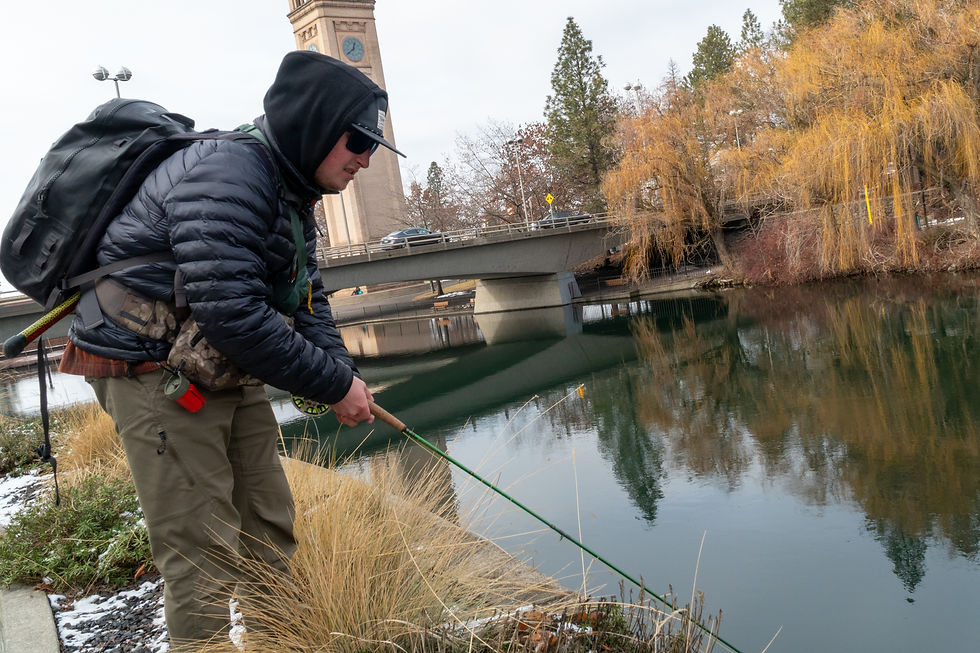
Going Solo and Lowering the Fly Rod Down
There’s also a more unconventional method some fly fishers use when they’re fishing solo from bridges or other high spots. It involves lowering the entire fly rod down toward the water. This can be done with almost any fly rod, but there’s a real risk of breaking the rod, so I strongly recommend using a less-expensive setup if you plan to try this. Practice helps, staying calm helps more. Here’s how it works:
Strip some line off the reel: After hooking the fish, strip line off the reel until you’ve created a generous loop of slack.
Pull the slack line out through the rod tip: This is where timing and smoothness matter. Carefully slide your hands up toward the rod tip so the rod is now hanging downward beneath you. This step requires confidence and care—this is where rod tips get snapped if things get rushed or jerky.
Lower the rod: You should be able to slowly “rappel” the rod down toward the water, hand over hand, keeping it controlled and stable as it descends.
Run: Once the rod is down, hustle quickly down to the bank because the fish will only stay on the line for so long. When you're back to the fly rod, grab it and quickly reel or strip in the excess line like hell. If you re-establish tension, and the fish is still on, great, but now you still need to finish the rest of the fight. This is black diamond, pro-ninja skill stuff, so failure and a lost fish is the norm.
This method isn’t elegant, and it’s definitely not foolproof—but in a pinch, it can work. Use it sparingly, practice it somewhere low-risk, and always accept that breaking a rod is part of the gamble. Here's a short video on Nic Hall doing the steps listed above.

Manage the Fight: Fish vs. Structure
When fishing from a fixed structure like a bridge or pier, structure can be both your friend and foe. It attracts fish (yay!) but can also help fish break you off (boo!). Here are some pointers for managing those structural hazards during a fight:
Keep Clear of Pilings: Many a fish has won its freedom by wrapping a line around a bridge piling or pier support. The instant you hook a fish, try to maneuver it away from any vertical pillars, anchor cables, or anything the line could wrap around.
Point the rod down towards the water and then use side pressure with your rod – if the fish is veering left toward a piling, swing your rod low and right to apply pressure from the opposite side, steering the fish’s head if possible. This is where a stout leader and tippet come in handy; you can put some muscle into it.
If the fish does manage to get around a piling, do not pull hard against the obstruction – you’ll saw through your leader. Instead, if you can, change your position to get a better angle and gently coax or wait the fish out. Sometimes giving slack will make a fish swim out from a snag on its own (it’s a gamble, but if you feel your line rubbing, sometimes it’s better to let the fish move a bit).
Every situation is different, but the overarching idea is to keep the fish in front of you and in open water as much as you can.
Time Your Moments: If you notice periodic hazards – for example, waves or boat wakes slamming into the pilings on a rhythm, or maybe floating debris drifting by – time your fight around them. If a big wave is coming, try to keep the fish away from the structure until it passes. If a boat is about to go under the bridge, maybe try to guide your fish to the side to avoid a collision course. This is fairly advanced stuff and often out of our control (because once a fish is on, chaos rules). But a little situational awareness can go a long way.
You vs. fish is normally a 1-on-1 battle; in high-angle fishing, it can feel like you vs. fish vs. the entire surrounding environment.
Know When to Let It Run: One counterintuitive tip: sometimes you shouldn’t try to stop a fish from running. If the far side of the bridge has no obstacles and the fish wants to bolt that way, maybe let it run (within reason) to tire itself in open water, rather than tightening down and having it pinball around right under you.
The more line out, the more stretch and shock absorption – which can actually help if a fish is thrashing close to structure. Of course, too much line out and you risk other issues (like running into other anglers’ lines or unseen snags). So it’s a judgement call each time. The main point is, keep cool and adapt your fighting style to the environment. High-angle fishing is not “set the hook and reel like mad” – it’s a strategic fight where you sometimes have to finesse and sometimes have to apply brute force, all in the span of a single battle.

Mind Your Surroundings (People and Traffic!)
When you’re fishing from a bridge or a busy pier, there will be pedestrians, cyclists, cars, joggers, and fellow anglers around you. Nothing will end your fishing day faster than hooking a random jogger in the ear on your backcast or tangling your line in the hood of a passing 18-wheeler. Here’s how to not become a local news story:
Backcast Safety: Always look behind you (or have your buddy watch) before you cast.
On a narrow footbridge or a pier lined with people, you may only have certain windows of time when casting is safe. It might sound extreme, but I’ve literally timed casts between pedestrians – wait for a gap, then whoosh, make my cast.
If you’re on a highway bridge with traffic whizzing behind, be extremely cautious. An 18-wheeler truck passing by can easily snag a fly line or leader if it’s arcing out behind you. Time your backcast in between vehicles if you’re that close to a road. Don’t get so into the fishing that you also step backward into a lane of traffic and become roadkill!
Give Others Space: Just as you need to watch your casting, be mindful of where you’re standing in relation to others. On a crowded pier, don’t cast over someone else’s line or camp right on top of where another angler is fishing.
If you hook a fish, communicate – yell “Fish on, coming through!” if you need to walk along the bridge to follow it. Most people will gladly get out of the way if you’re polite and let them know. Likewise, be ready to reel up your own line if another angler near you hooks a fish and needs the clearance.
Pier and bridge fishing often require a bit of choreography with those around you. Follow the local etiquette: some busy piers even have unspoken rules, like rotating spots or designated areas for certain types of casting. When in doubt, just chat with the regulars – some anglers will share tips as you get to know each other.
Watch Your Line (Even When Not Casting): In places like pedestrian bridges or boardwalks, a dangling fly line can trip people or get caught in strollers, bicycles, etc. Try to stand such that your line mostly stays over the water, not across the walking path. If you’re stripping line out, keep the excess coiled at your feet (or use a stripping basket) so it’s not lying across where people step.
Here is worth mentioning the steeple cast. This cast uses a very high trajectory on the backcast then changes plane to send the fly out to the target. It's essentially a vertical backcast, which is useful when you're on a narrow bridge with obstacles behind you and overhead. Here's a video on how to perform the steeple cast.
Noise and Courtesy: Bridges in urban areas mean people might not expect to see someone fishing.
You might get curious questions – be friendly and educate folks, it builds goodwill. But also be prepared for the occasional grump who thinks you shouldn’t be there.
As long as you’re legally allowed, you have the right to fish, but always stay calm and courteous. Sometimes simply explaining what you’re doing (“Yep, just trying to catch a bass down there, I’m being careful not to hook anyone”) can diffuse tension.
And do your part: don’t leave a mess. No one will welcome anglers if we leave trash or tangled line on a public walkway.

Respecting the Rules
Be sure to do your best to respect posted signs and regulations when fishing from bridges or other high places (it's tough, I know, to stop yourself from casting when there are fish right below you). If there’s a big sign that says “NO FISHING”, that’s usually there for a reason. It could be for public safety, to protect a sensitive area, or because too many anglers caused issues in the past.
Know Legit Signs vs. Questionable Signs: Occasionally, you might run into a sign that seems… off. Perhaps a spot that’s traditionally been public suddenly has a crudely made “No Fishing” sign that doesn’t cite any ordinance or authority. It might make you wonder, “Is this crap even legit?”
There have been cases of private citizens putting up bogus signs to hog a spot or deter people. If you suspect a sign isn’t official (say, it lacks a city logo or code, or it’s on public land where fishing is normally allowed), don’t just ignore it – the smarter move is to verify with authorities.
You can contact your local game warden or fisheries department and ask, “Hey, is fishing actually prohibited at XYZ bridge? I saw a sign but it didn’t look official.” They’ll let you know what’s what. In many places, an official no-fishing area will be backed by a law or municipal code (often noted on the sign in fine print). If that context isn’t there, then it might not be legit. That said, do not remove or deface the sign yourself – even if it’s unofficial, that could be seen as vandalism by random people passing by. Just seek clarification through proper channels.
When in Doubt, Don’t Cast: If you aren’t sure about the rules at a location, hold off on fishing until you find out.
Ask locals, check online resources (state wildlife agency sites often list closed areas), or call up the local park authority. Fishing somewhere you’re not supposed to can result in fines, confiscated gear, or even arrest in extreme cases. Not to mention, it could jeopardize access for everyone if an incident occurs.
One common scenario: some bridges allow fishing only from certain areas (like not on the traffic side, or only on designated walkways). Make sure you’re in the right spot. And watch for time-of-day restrictions too; a bridge might allow fishing in daylight but not at night if it’s a safety concern.
Fishing Smarter to Try to Avoid for New Bans: To a degree, we need to consider how we act while fishing off of bridges, walkways, and other elevated spots.
Imagine a scenario: a bunch of anglers trash an area or constantly endanger pedestrians with careless casting – it’s only a matter of time before authorities slap up a “No Fishing” sign there. Conversely, if we pick up our litter, interact with the public gracefully, and handle the fish with respect (whether we're catching-and-releasing or catch-and-keeping), there’s little incentive for authorities to shut it down.
Not everyone loves seeing someone fishing off a city bridge, but we can win some of them over and maybe even helping educate others about the local fish (“Yes, there are actually fish living in this concrete canal.”).
Legal Primer: One interesting legal tidbit: in many places in the U.S., navigable waters are public, but the access point might be controlled. For instance, the river under the bridge might be fair game, but the bridge itself could be off-limits if it’s private property or explicitly regulated. Or vice versa: the bridge is public, but the water is a protected area. Make sure you have any required licenses (some piers have blanket licenses covering anglers, but most bridges require you to have your own state fishing license). If keeping fish, adhere to size and bag limits strictly – enforcement officers do check these popular spots.
Basically, be a by-the-book angler when you’re in a conspicuous high place. It’s not like sneaking off to a secret stream in the woods; you’re literally fishing on Main Street, so expect to be noticed and expected to follow rules to the letter.

Share the Knowledge and the Fun
High-angle fly fishing – whether from bridges, piers, or those random boardwalks – is a bit of a niche in the angling world. A lot of people may not even realize it’s possible or productive. By doing it responsibly, you’re kind of an ambassador for the style. So, help others learn the ropes:
Coaching and Mentoring: If you see another angler struggling to land a fish from a high spot, or setting up in a precarious way, lend a friendly word of advice (if they’re open to it). For example, you might say, “Hey, need a hand netting that fish?” or “Careful on that cast, it’s easy to snag that light pole – I’ve done it!”
Sharing tips in a respectful, non-condescending way helps create a supportive atmosphere. We want newcomers to feel welcome, not embarrassed. Remember, we were all beginners at some point, and this high-place fishing has a learning curve for sure. By mentoring others, we ensure the practice continues safely and doesn’t get shut down due to avoidable mistakes.
Lead by Example: While we all make mistakes and push the limits (myself included), often the best way to teach is just by doing your thing the right way.
People watch and learn. If others see you using a net and carefully releasing fish, they’ll catch on that this is the norm. If they observe you checking over your shoulder before each cast to check for people passing by, they might realize, “Oh, I should do that too.” It’s a subtle form of peer education. And if someone does ask you directly, consider being generous with knowledge. What flies are working, what setup you use, etc. – the goodwill you build can come in hand later on.
Enjoy the Spectacle: One fun aspect of fishing in urban/high places is you often get an audience.
People are naturally curious when they see an angler in an unexpected spot. Don’t be surprised if tourists start taking photos, or a kid on an e-scooter screeches to a stop to watch wide-eyed as you cast. Embrace it! These positive interactions leave non-anglers with a good impression of our practice. So yes, you’re on stage a bit when fishing high-profile spots – represent us well!
Community Matters: If there’s a local community or online group for the area you fish, consider plugging in. Often bridge and pier anglers have forums or social media groups where they share reports and advice.
It’s also a good way to stay updated on any changing rules or issues (for example, if the city is considering a ban on bridge fishing due to complaints, you might hear about it and can voice your perspective). Strength in numbers can sometimes help preserve access, too – an organized group of respectful anglers is more likely to be heard by local authorities than lone individuals.

Fly fishing from bridges, boardwalks, piers, and other high perches offers a thrill for the adventurous angler. It’s part strategy game, part adrenaline rush, and yes, part high-flying circus act at times. With the right planning, gear, and mindset, you can safely land fish from spots many would never think to cast a fly rod. Always remember to plan before you cast, use the proper tools, and be hyper-aware of your surroundings and regulations. Bring a fishing buddy when you can, and be willing to be that friendly mentor when others show interest. High-angle fishing can be perfectly legal and sustainable – but only if we do it with respect for safety, the fish, and the public.
Now that you’re armed with knowledge, it’s time to give it a try. Pick a spot that’s allowed, double-check your gear, and go experience the unique joy of pulling a fish up from the depths while you stand high and dry. It might not be the most orthodox way to fly fish, but it sure is effective and endlessly interesting.

Comments